| ||||||||||
Latest Posts
Showing posts with label domestic violence. Show all posts
Showing posts with label domestic violence. Show all posts

Women Are Aggressors in Household Violence Too
It is a know fact to everyone except those ignorant feminists who choose to ignore that issue as they pursue the "All Women are Victims" mantra. A subject that does appear to be a losing reality as more and more studies and facts hit the public arena. Those of you who have witnessed female violence at home or when out and about (Nightclubs etc.) already know the truth of it. The feminist hegemony is saturated with lesbian feminists, they too would be well aware of the fact that lesbians (they would be females too, I am thinking) smack the bejesus out of each other even more than heterosexual couples do, and that's a fact as well..
The notion among feminists, lesbians - among women in general - is that this is a male problem. It's part of an older lesbian-feminist paradigm which says most of the problems in the world come from men and if we could isolate ourselves from them, then things would be kind of idyllic. It's not true. But people in lesbian communities don't want to talk about that publicly. It's like airing dirty laundry. Source: Ros Davidson, " Gay-on-Gay Violence: The gay community's dirty secret - domestic violence - is finally coming out of the closet," Salon Magazine, February 27, 1997.
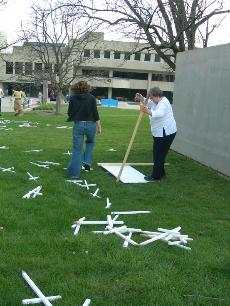 |
| Feminists destroy anti-abortion protest.. |
But they keep promoting the lies and misinformation like there are still people around who are stupid enough to believe their biased erroneous claims..
The interesting part about the article is the responses as that particular article makes some spurious claims as female journalists do, like
"Perhaps it began with early female action figures. Perhaps with "Charlie's Angels." Or maybe with scores of elementary girls playing soccer, or with older girls playing contact sports at elite levels."Erm, NO. It is not like females have all of a sudden become abusive, they have been abusive all along. It is recognised more as MRAs have continually demonstrated and exposed, unquestionable facts. But it's not the part of reality that feminists and female journalists want to highlight, they prefer to bury it under the carpet and live in denial as they have done all along..
Most likely we will never know exactly how or when it became okay to talk about female aggression--female-to-female aggression and female-to-male aggression. Whatever its origins, this new narrative is challenging the once omnipresent scenario of the male violent aggressor–passive female victim scenario. It is now increasingly acceptable to talk openly about female aggression and to conduct serious research on this topic.So realisation has finally surfaced and the truth must now be stated..

We now know that women-on-women aggression is far from rare and that women are often the initiators of male-female aggression. Surveys of U.S. households have found rates of wife-to-husband violence "remarkably similar" to those of husband-to-wife violence. And an early cross-cultural survey did not find that men were significantly more aggressive than women.So we have the responses to the article, laying out the truth -
Submitted by gwallan
What saddens me is the aggressive rejection experienced by victims whose only crime is being the wrong gender or, even more pitifully, being abused by somebody of the wrong gender. What clinically depresses me is victims being called liars and/or laughed at by services promising to help victims. What angers me is the ongoing parade of female sexual abusers being treated as a victim and NEVER punished. What makes me borderline murderous is the woman who rapes a twelve year old boy and then gets child support from her victim with the help of government agencies and lawyers.
I hope you and others enjoy your political and legal shenanigans way up there in your air conditioned ergonomic offices. I get to see and deal with the real casualties and it is not pretty. We're sick to death of the lies. We're sick to death of gender political doctrine erasing victims from view. Look inside yourself critically for a change. If your allegiances to women are what drives you rather than concern for all victims then get the h*ll away from ANYTHING to do with victims. Every lie you allow inevitably hurts another victim somewhere.
"Blaming women is such a cottage industry I guess it's hard not to make money on it when we can."
This did the trick though. Eusticia must be weeping at the cynicism done in her name.
Submitted by fondueguy
" Women could surely find ways to actually physically harm their male partner, but, do not"
This dialogue is simply false.
According to http://www.ncbi.nlm.nih.gov/m/pubmed/10989615/
women are only somewhat more likely to be injured, and constitute 62% of those injured in dv.
women are only somewhat more likely to be injured, and constitute 62% of those injured in dv.
It is strange to see you to juggle the idea of women being weak/helpless while at the same time realizing that women are not incapable idiots. Surely you can put two and two together, and see that the since women are capable of hurting a man, and some of them are aggressive, that some women will injure men by means of surprise, weapons, drugs, or sleep.
And I hope you do not seriously mean to say that hitting someone without injuring them is not damaging. Not only is that bad in and of itself, but it can lead to escalation and it will damage the children who see it.
You only help men and women by being honest about the problem and stopping the cycle.
The other interesting issue is, as Kim Kardashian demonstrates, if a male were to hat a female as hard as she does to him, I would imagine the end result being different as well. It comes down to the bulk and strength issue. Most women have a problems squatting lies and therefore are seen to be weaklings. They would be in the minority as not all are fawning doves but that's the image they preserve and protect for self preservation..
They were responding to this usual bit of misandry. It is part of large response but one does not have to guess which hegemony she comes from..
Submitted by Janet Women could surely find ways to actually physically harm their male partner, but, do not,..
The Domestic Violence Industry has been gearing up for decades while at the same time introducing feminist doctrine where the only victim is the female, with the majority of services aimed primarily at helping her while living in denial of the fact that females are violent towards their partners..
Feminists have honed into the sex angle for emotive reasons, highlighted just that facts and denied any facts where it demonstrates that females are sexually abusive and physically abusive as well..The entire Domestic Violence Industry is geared to single out males and ignore the growing abusive nature of women..
Almost the Last Word on Family Violence ?
 In the 1970s and 80s, two contrasting views on violence emerged. The experience of women in anecdotal and research reports led to the view that domestic violence was overwhelmingly perpetrated by men against women. During the same period, large scale studies by sociologists indicated that in intimate partner violence women were as violent as men. The two groups have remained apart and at loggerheads until recently when conferences and better analysis have contributed to some measure of agreement.
This development is encapsulated in the findings of the 2007 Wingspread Conference, held in Racine, Wisconsin, USA. It has also been dealt with comprehensively by Kelly and Johnson in a recent edition of the Family Court Review. The following is a summary of that article.
Research over the past ten years has convincingly demonstrated that there are different types of partner violence to the extent that it is meaningless to speak of domestic or family violence without specifying the type of violence contained in a particular incident. This research has also shown that the view that men are the main perpetrators of violence is not valid, nor is the view that women are never or rarely violent.
Joan Kelly and Michael Johnson (Family Court Review, 2008 Vol 46, 3, pp476-499)describe four types of intimate partner violence:
- Coercive Controlling Violence or a pattern of emotionally abusive intimidation, coercion, and control coupled with physical violence.
- Violent Resistance ie to a violent, coercively controlling partner. Violent Resistance indicates the reality that both women and men may, in attempts to get the violence to stop or to stand up for themselves, react violently
- Situational Couple Violence, is used here to identify the type of partner violence that does not have its basis in the dynamic of power and control.
- Separation-Instigated Violence is used to describe violence that first occurs in the context of separation.
- Some experts add Violence arising from Mental Illness to the above list.
Coercive Controlling Violence includes intimidation, emotional abuse, isolation, minimizing, denying, and blaming, use of children, economic abuse, coercion and threats. In heterosexual relationships, most studies show that Coercive Controlling Violence is perpetrated primarily by men. However, even studies limited to small samples have found female perpetrators in 3% to 13% of cases, warning that this phenomenon should not be ignored. In fact there has been little research into female controlling violence.
Violent Resistance is a form of self-defence to Coercive Controlling Violence.
Most studies show that this violence is a response by women to an attack by their partners male or female to protect themselves or others from injury.
Situational Couple Violence is the most common type of physical aggression in the general population of married spouses and cohabiting partners, and is perpetrated equally by both men and women. Generally, Situational Couple Violence results from situations or arguments between partners that escalate on occasions into physical violence. One or both partners appear to have poor ability to manage their conflicts and/or poor control of anger. It often involves minor forms of violence eg pushing, shoving, grabbing, and may include cursing, yelling, and name calling.
Situational Couple Violence is initiated at similar rates by men and women, as measured by large survey studies and community samples. In samples of teenagers and young adults (dating, cohabiting, married), research has indicated that females are more violent than males.
Separation-instigated Violence is violence that occurs at separation where there is no prior history of violence between the partners. It may be triggered by experiences such as a traumatic separation eg the home emptied and the children taken when the parent is at work, public humiliation of a prominent professional or political figure by a process server, allegations of child or sexual abuse, or the discovery of a lover in the partner's bed. The violence represents an atypical and serious loss of psychological control (sometimes described as "just going nuts"), is typically limited to one or two episodes at the beginning of or during the separation period, and ranges from mild to more severe forms of violence.
The research indicates that this form of violence is perpetrated equally by men and women.
Current research shows how important it is to avoid speaking in generalities about family violence. Differentiating and describing the type of violence in a given situation will assist those required to make recommendations and decisions about custody and parenting plans, treatment programs, and legal sanctions.
These considerations show the need for improved screening measures and procedures in civil, family, and criminal courts, and the need for better decision making, appropriate sanctions, and more effective treatment programs tailored to the characteristics of different types of partner violence. In the family court, reliable differentiation should provide the basis for determining what safeguards are necessary and what types of parenting plans are appropriate to ensure healthy outcomes for children and parentchild relationships.
In February 2007 the National Council of Juvenile and Family Court Judges and the Association of Family and Conciliation Courts brought together a working group of thirty-seven experienced practitioners and researchers to identify and explore conceptual and practical tensions that have hampered effective work with families in which domestic violence has been identified or alleged. The participants included members of the domestic violence advocacy community; family court judges and administrators; lawyers and mental health, dispute resolution, and other professionals working in the family court system; and academics from the fields of law and social science. This has come to be called the Wingspread Conference.
A useful work on the deliberations of the conference and its outcomes is by Nancy Ver Steegh and Clare Dalton in The Family Court Review, 2008, vol s46, 3, pp 454-475. In a significant passage, the authors state:
- "Families who experience domestic violence differ from one other in significant ways. Violent behavior may range from an isolated incident to pronounced patterns that recur over time, often escalating in intensity and frequency. Infrequent or occasional physical violence may or may not be accompanied by other forms of abuse, including threats, sexual coercion, verbal abuse, isolation, and financial control. The level of prior physical violence may or may not be a reliable indicator of future risk or lethality. The violence may be complicated by other problems such as mental illness or substance abuse. Finally, while researchers agree that exposure to domestic violence is harmful to children's development, not all children are equally affected; there are multiple factors that influence children's well-being and contribute to decisions about their best interests. Frequently the law of any given state or jurisdiction imposes a definition of domestic violence that is both under- and over inclusive and demands uniform treatment of families that fit the definition, despite growing recognition that they are not all alike."
There was agreement amongst participants at the conference that a one-size-fits-all definition and approach to family violence was unhelpful and meaningless. There was consensus that each domestic violence situation must be closely examined to determine its seriousness, the risk of future violence, and the presence of other forms of intimidation. Critical variables identified by conference participants included: the frequency, intensity, and recency of the violence; the presence of sexual coercion or abuse; the existence of nonphysical coercive strategies including verbal abuse, threats, isolation, and financial control; the presence of an established history of violence, criminal activity, substance abuse, or mental health issues; the determination of "who is afraid of what"; the needs, interests and well-being of children; any history of child maltreatment; and the extent to which the violence is consistent with a recognized pattern with proven implications for ongoing risk or the utility or impact of particular interventions or determinations. Family strengths and protective factors should also be taken into account and supported.
There was lengthy discussion on the categorisation of different forms of violence, as described by Kelly and Johnson. There was no overall agreement in this area. However, there was acknowledgement that categorisation could be useful if applied carefully and did not ignore the fact that some family situations are complex and not open to over-simple categorisation.
Verizon's misinformation in their latest DV promotion demonstrates once again that telling the truth is not part of their overall agenda or strategy but promoting disinformation is..
To blame Fathers solely for DV disregards and ignores the fact that Mothers are the greater child abusers and are also as inclined towards domestic violence then her partner.. Verizon totally disregards, ignores this vital information and instead spread male hate (misandry) instead..Domestic Violence will never be halted by stopping only one partner from fighting while the other has carte blanche. This sexist attitude and discrimination against Fathers has to stop as it will never solve anything..
The Verizon Foundation and the National Domestic Violence Hotline Team Up for Some Man-Hating
Harry Crouch
December 1, 2011
December 1, 2011
“I feel that ‘man-hating’ is an honorable and viable political act, that the oppressed have a right to class-hatred against the class that is oppressing them.” — Robin Morgan – former president of the National Ourganization for Women (NOW) and editor of MS magazine
Last week we became aware of the Verizon Foundation’s and National Domestic Violence Hotline’s video Monsters.
We mailed and/or emailed 28 leaders of both organizations an open letter strenuously objecting to their outrageous man-hating video.
Before reading the letter we sent both those organizations or more of what is below please watch or re watch the video.
Now that you have seen it or seen it again ask yourself if you can imagine yourself in the room full of people who conjured up this video. How many people do you see? How many meetings were there? Which million dollar conference rooms were used in Verizon and NDVH buildings? How many men and how many women were in the conferences?
Try to imagine all that and the conversations that led to the production of this horrific misandric boy bashing video. I cannot come close to imagining myself in such a room, being surrounded by however many people were there all blinded by some ill conceived and irrational ideology that drives them to the conclusion that only boys grow tall to become abusers.
These people are either ignorant or hateful or both. If ignorant they can be educated, if hate filled ideologues with hidden agendas there is little or no reason to believe reality and truth will have any bearing on their self-serving idiocy.
And, wouldn’t you like to know that one someone, the first person in this group of man-hating sociopathic pariahs that came up with the idea for Monsters?
If challenged that person and her defenders will deny, justify, rationalize, and blame it on a kid, the little girl, if she really exists, whose ugly vision this video purportedly shares. I sure would, I want to know. Then could put on a full court press to get whoever it was fired, if not somehow imprisoned.
If challenged that person and her defenders will deny, justify, rationalize, and blame it on a kid, the little girl, if she really exists, whose ugly vision this video purportedly shares. I sure would, I want to know. Then could put on a full court press to get whoever it was fired, if not somehow imprisoned.
You won’t see this video on network television, it’s a weird length ill suited to program scheduling. It will live on the Internet and be proudly shown around the country at domestic violence council meetings; used for training public safety officers, forced on the military for awareness training, and paraded at fundraising events put on by domestic violence shelters, family justice centers, and even struggling university women studies programs. Oh, and yes, it will be introduced into our schools perhaps even as early as first grade.
This video has the potential for spreading harm and hate for decades. It has to be stopped, withdrawn, and destroyed.
Please help. Our letter includes the mailing address, email addresses, and even some phone numbers to those that have the power to stop this pure propaganda mind-warping travesty of a video. Write letters, send emails, and make phone calls to your legislators too; also, your local Verizon company executives and newspapers.
Please feel free to reprint our letter and mail or email it, turn it into handouts, flyers and so forth. Also, please distribute a link to this page to as many people as you can.
Become part of the solution and help us help others protect our children and future generations by ensuring this video is pulled from the Internet, is not distributed, and destroyed.
How is it we allow such hate-mongers to gain such power? I just don’t get it.
Each and every mantra or doctrinal claim included in the Feminist arsenal can be cited as either being blatantly dishonest, exaggerated or a downright lie. Here is one of those downright lies that feminists have been perpetrating for so long that making people believe otherwise or convincing people about the truth will be an uphill battle as feminists will fight this tooth and nail as it would put an end to their falsehood about "all women are victims" claim. A claim that has generated copious laws and unlimited funding thrown into their coffers to continue their fascist, male hating methodology without restriction or opposition from any of those elite who were elected to protect the people. They failed and continue to do so..Vote them out..
The Centers for Disease Control recently funded a major study of heterosexual relationships throughout the U.S. and found: "Almost 24% of all relationships had some violence, and half (49.7%) of those were reciprocally violent. In nonreciprocally violent relationships, women were the perpetrators in more than 70% of the cases," and both sexes suffered significant injuries.http://www.ajph.org/cgi/content/abstract/97/5/941 The same study also found: "More women than men (25% versus 11%) were responsible. In fact, 71 percent of the instigators in nonreciprocal partner violence were women" and "while injury was more likely when violence was perpetrated by men, in relationships with reciprocal violence it was the men who were injured more often (25% of the time) than were women (20% of the time)."http://pn.psychiatryonline.org/cgi/content/full/42/15/31-a Men are less likely to report it (which makes crime data unreliable), but almost 300 studies now confirm "women are as physically aggressive, or more aggressive, than men in their relationships with their spouses or male partners," as California State University Professor Martin Fiebert shows in his online bibliography at http://www.csulb.edu/~mfiebert/assault.htm For example, a 32-nation study by the University of New Hampshire found women are as violent and controlling as men in dating relationships worldwide. http://www.unh.edu/news/cj_nr/2006/may/em_060519male.cfm?type=n andhttp://pubpages.unh.edu/~mas2/ID41E2.pdf When children witness either parent hit the other, regardless of how severe or minor, it becomes a model for them to follow. Domestic violence is an intergenerational cycle, and we'll never stop that cycle without being honest about it rather than following the politically correct gender paradigm that has been totally refuted by serious researchers like Professor Don Dutton of the University of British Columbia and many others.
This Canadian government report also recognizes the above data:
http://www.phac-aspc.gc.ca/ncfv-cnivf/pdfs/fv-intime_e.pdf
Here we have the typical anti male bias that government departments have introduced and maintain at all costs. The blatant sexism demonstrated must be overcome and equality must be reintroduced so both sexes have the same rights as each orther. Unfotunately, this is one issue that feminists fight every which way they can. They do not give a damn about Men's Health or violence against against men and boys in any way, shape or form, as all they are interested in is maintaining the status quo while men pay, in more ways that ever before..
Mandate for DV Screening Is A Slap in the Face to Men.Dear Christian,
The U.S. Department of Health and Human Services released its Women's Preventive Services requirements for qualified health plans yesterday. Some of the rules are reasonable, like screening for diabetes in pregnant women.But the document requires that health plans conduct "screening and counseling for interpersonal and domestic violence" on an annual basis for women...but not men:http://www.hrsa.gov/womensguidelinesThe rule was issued exactly three weeks after Catherine Becker of California drugged and bound her husband. Then she severed and disposed of his genitalia. If he had sought medical care prior to the incident and the doctor had performed an abuse screening, it's possible the gruesome event never would have occurred.When the rules were announced, HHS Secretary Kathleen Sebelius explained, "These historic guidelines are based on science and existing literature." Over 250 studies show women are at least as likely as men to engage in partner violence. A rule that mandates domestic violence screening only for women ignores science and ridicules the notion of gender equity.Contact Secretary Sebelius RIGHT NOW atKathleen.sebelius@hhs.gov . Then call Assistant Secretary for Health Dr. Howard Koh at 202-690-7694.Respectfully tell them the DV screening requirement of the Women's Preventive Services guideines is unreasonable and a slap in the face to male victims of domestic violence. Tell them to promptly revise the discriminatory guideline to include both men and women.Sincerely,Teri
Teri Stoddard, Program DirectorStop Abusive and Violent Environments
www.saveservices.orgP.S. Help us grow our efforts....forward this E-lert to a friend!


